
Green Hydrogen Refueling Stations in Europe: Engineering Challenges, and Design Considerations
The Rise of Green Hydrogen Mobility in Europe
As Europe accelerates its transition toward carbon neutrality, hydrogen is becoming one of the key energy carriers for decarbonizing transport. While battery-electric vehicles dominate the passenger car segment, hydrogen fuel cell technology is increasingly viewed as the preferred solution for heavy-duty transport, long-haul trucking, buses, rail applications, and specialized industrial fleets.
Green hydrogen that is produced through water electrolysis powered by renewable energy sources, plays a central role in the European Union's climate strategy. The expansion of hydrogen mobility requires not only hydrogen production facilities but also a reliable network of hydrogen refueling stations (HRS).
Today, Europe operates more than 250 publicly accessible hydrogen refueling stations, with several hundred additional projects under development. The market continues to expand through national hydrogen strategies, EU funding mechanisms, and the Trans-European Transport Network initiative, which aims to establish hydrogen refueling infrastructure along major transport corridors.
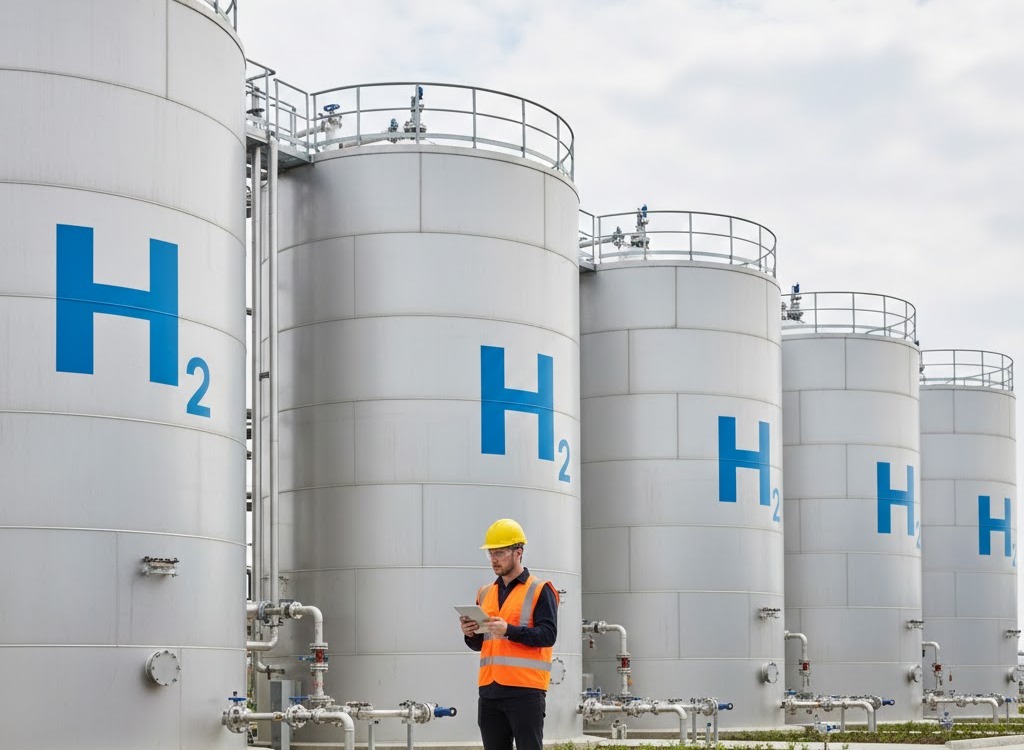
Hydrogen Refueling Stations Across Europe
Hydrogen refueling infrastructure is currently concentrated in countries that have adopted ambitious hydrogen strategies and support programs.
Germany
Germany remains the European leader with more than 100 hydrogen refueling stations in operation. The network is primarily developed by H2 MOBILITY Deutschland and covers major highways, logistics hubs, and metropolitan regions.
France
France continues to expand its hydrogen ecosystem, focusing on public transport, commercial fleets, and regional hydrogen valleys. Dozens of stations are already operational, with many more under construction.
Netherlands
The Netherlands is investing heavily in hydrogen infrastructure to support logistics and port operations, particularly around Rotterdam and other industrial clusters.
Scandinavia
Denmark, Sweden, and Norway continue developing hydrogen corridors connecting major transport routes and supporting heavy-duty transportation.
Belgium
Belgium's hydrogen development is closely linked to its ports and industrial zones, where hydrogen is expected to play a significant role in future energy systems.
Spain and Portugal
The Iberian Peninsula is emerging as one of Europe's future green hydrogen production centers. New hydrogen refueling stations are being planned alongside large-scale electrolyzer projects and renewable energy developments.
Central and Eastern Europe
Countries including Poland, the Czech Republic, Austria, and others are beginning to establish hydrogen infrastructure as part of broader decarbonization initiatives and EU-funded projects.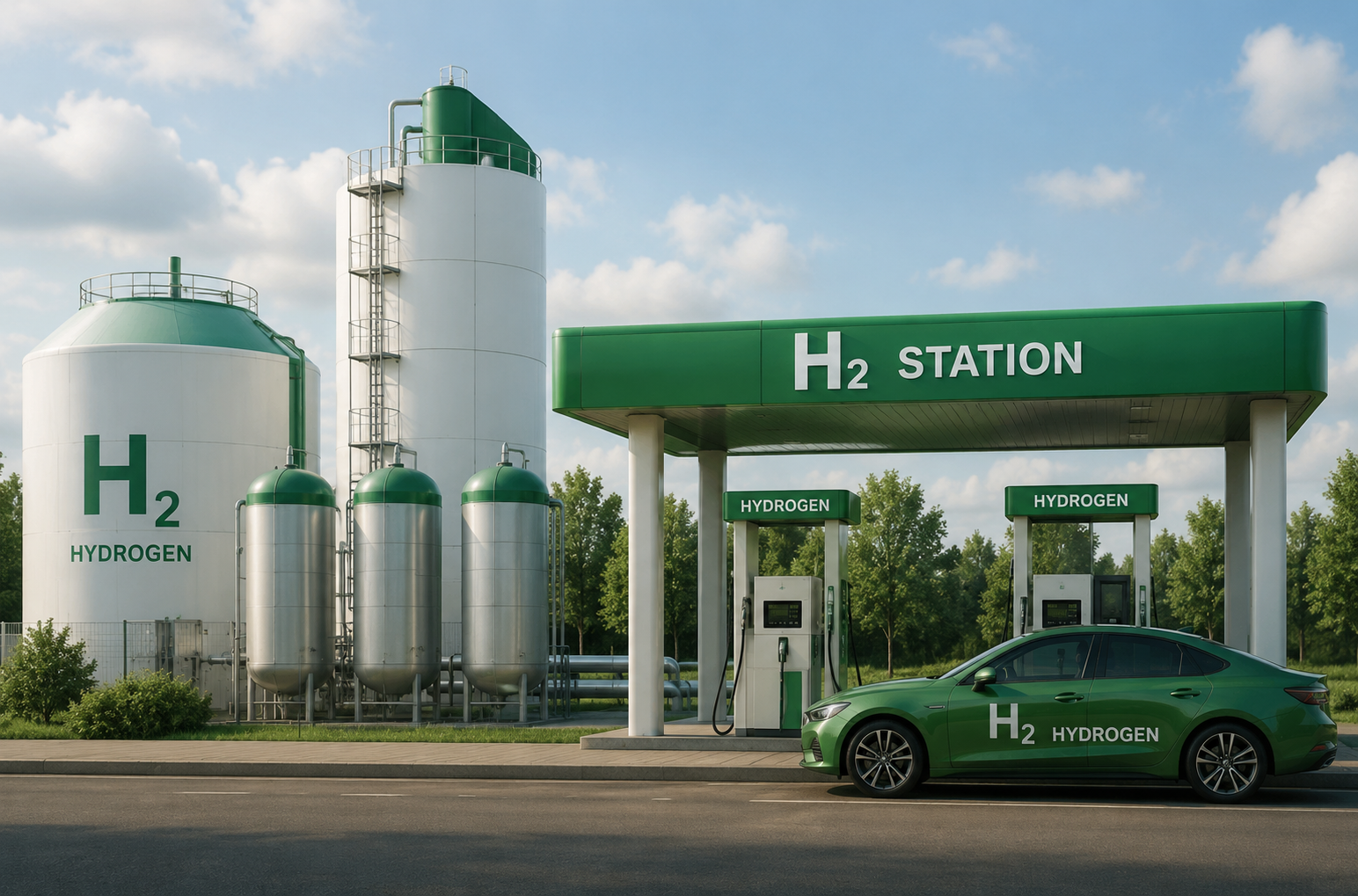
Why Hydrogen Refueling Stations Are Growing in Popularity
Several factors drive the rapid deployment of hydrogen refueling infrastructure:
- Decarbonization of heavy-duty transportation
- European Green Deal objectives
- Expansion of green hydrogen production capacity
- Increasing availability of fuel-cell trucks and buses
- Development of hydrogen transport corridors
- Energy security and diversification of energy sources
- Support through national and European funding programs.
Unlike battery-electric solutions, hydrogen enables rapid refueling and longer driving ranges, making it particularly attractive for commercial transport and logistics operations.
How a Green Hydrogen Refueling Station Works
Depending on the project concept, hydrogen can be delivered by tube trailers, pipelines, or produced directly on-site through electrolysis.
Simplified Process Flow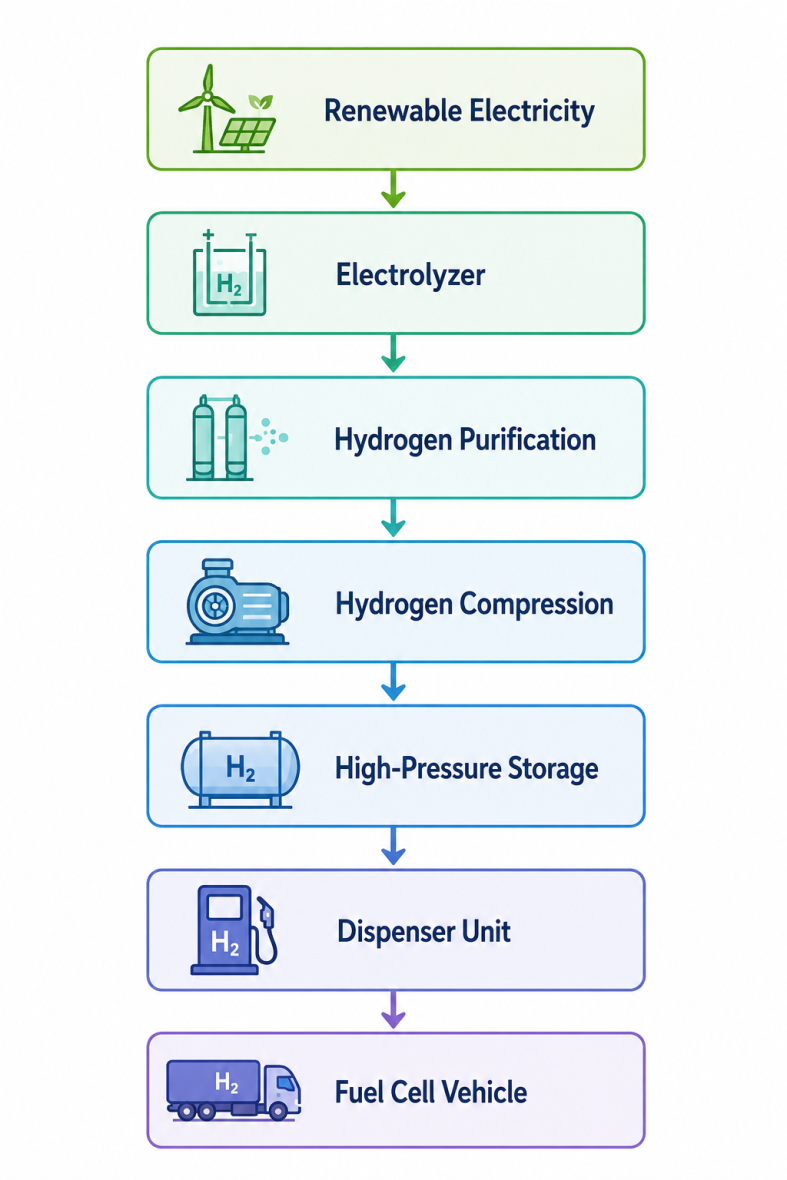
For larger installations, additional systems may include buffer storage, cascade filling systems, cooling equipment, pressure reduction stations, and operational control systems.
Engineering Scope of a Hydrogen Refueling Station
Hydrogen refueling stations projects include multidisciplinary design and engineering disciplines.
Site Development and Civil Engineering
The design process begins with site selection, master planning, grading, drainage design, road access, and utility coordination.
Typical civil infrastructure includes:
- Internal roads and maneuvering areas
- Foundations for process equipment
- Utility networks
- Stormwater management systems
- Fire access roads
- Security fencing and controlled access zones.
Architectural Design
Although process equipment is the core of the facility, architectural design remains important for:
- Operator buildings
- Technical buildings
- Electrical substations
- Control rooms
- Customer service areas.
Modern hydrogen stations increasingly incorporate sustainable architectural solutions and BIM-enabled coordination.
Structural Engineering
Structural design covers:
- Equipment foundations
- Pipe racks
- Compressor skids
- Storage vessel supports
- Canopies
- Steel structures and maintenance platforms.
Hydrogen-related facilities require special consideration of dynamic loads, vibration, and safety clearances.
Electrical Engineering
Electrical systems design typically include:
- Medium-voltage and low-voltage distribution
- Transformer substations
- Power supply for electrolyzers and compressors
- Backup power systems
- Grounding and lightning protection
- Energy metering systems.
For stations with on-site hydrogen production, electrical loads can be substantial due to electrolyzer operation.
Instrumentation, Control and Automation
Advanced automation systems ensure safe and efficient station operation.
Typical project include:
- Control systems
- Gas detection systems
- Emergency shutdown systems
- Fire and gas systems
- Remote monitoring platforms
- Cybersecurity infrastructure.
Mechanical Engineering
Mechanical engineering encompasses:
- Hydrogen compression systems
- HVAC systems
- Water treatment systems for electrolysis
- Pressure control equipment.
Process Engineering
Process engineering forms the technological backbone of the project.
Engineering activities include:
- Process design basis development
- Process flow diagrams
- Piping and Instrumentation Diagrams
- Hydraulic calculations
- Mass and energy balance calculations
- Process safety analysis
- Hazard identification studies (HAZID)
- Hazard and Operability Studies (HAZOP).
Piping Engineering
Among all design disciplines, piping engineering plays an important role in hydrogen projects.
Hydrogen presents unique challenges due to its low molecular weight, high diffusivity, and potential hydrogen embrittlement effects on certain materials.
A comprehensive piping engineering package typically includes:
- Piping material specifications
- Pipe routing and layout design
- Stress analysis
- Flexibility analysis
- Isometric drawings
- Pipe support design
- Valve selection
- Hydrogen-compatible material selection
- Pressure drop calculations
- 3D BIM-based piping modeling.
The integration of piping systems within confined station layouts requires close coordination between process, structural, electrical, and mechanical disciplines. Our internal BIM workflows are automated with plugins that significantly improve clash detection, constructability reviews, and multidisciplinary coordination.
For hydrogen infrastructure projects, BIM significantly reduces project risks during both design and construction phases.
ENECA Expertise in Hydrogen and Industrial Infrastructure
While ENECA has not yet delivered a dedicated hydrogen refueling station project, our engineering teams have successfully participated in green hydrogen production projects, including electrolyzer-based facilities and associated industrial infrastructure. This experience provides a technical foundation for future hydrogen mobility projects. We closely follow the evolution of the European hydrogen market and believe that hydrogen refueling infrastructure will become a key element of the future energy ecosystem. By combining multidisciplinary engineering expertise, advanced BIM methodologies, and extensive industrial project experience, ENECA is ready to support clients in the development of next-generation hydrogen refueling stations across Europe.