
Liquid oxygen storage
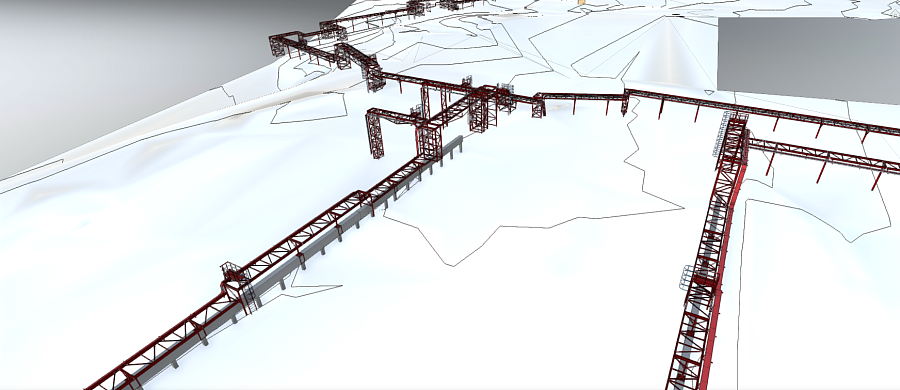
The project involves the construction of cryogenic tanks with a total capacity of 500 m³ for liquid oxygen storage. Key elements include:
- Installation Site: A designated area for two cryogenic tanks.
- Tank Specifications: Two horizontal cryogenic tanks, each with a capacity of 250 m³ and a maximum working pressure of 3 bar.
- Gas Distribution: A gas dispensing platform with three connection points.
Tank Design
Each tank (diameter: 4.5 m, length: 24.5 m) will be supported by reinforced concrete foundations. The design features an inner vessel made of alloy steel for the cryogenic liquid and a carbon steel outer vessel for protection, anchored to the foundation.
Operational Features
The tanks are equipped with evaporators for long-term storage and distribution. The space between the vessels is insulated with powdered perlite. Additional features include:
- Technological pipelines and safety valves.
- Level and pressure sensors for monitoring.
Liquid Management
Cryogenic liquid is received via pipelines from an air separation unit or truck. Liquid is dispensed through a lower pipeline, with safety systems in place to prevent pressure build-up.
Safety and Infrastructure
A dual centrifugal pump system is included for liquid discharge. New technological communications will be established to support the facility. The premises comply with sanitary standards for lighting, climate control, and noise levels, and are equipped with necessary office furniture and fire safety equipment.
Based on their experience, I can recommend Eneca.

We appreciate Eneca’s readiness to support us with BIM modeling on short notice, as well as their flexibility in providing the necessary resources to meet a strict deadline. All modeling was completed within two weeks, with a division into lots. Eneca’s specialists were always willing to take the time to discuss our concerns and accommodate additional requests.
Eneca’s strong expertise in Revit and professional experience in structural design enabled their team to quickly grasp Implenia’s high modeling requirements. The BIM model was developed in accordance with the 3D BKP Model guidelines and Implenia’s standards, ensuring compliance with parameter and element naming rules as per Baukostenplan Hochbau. Eneca’s detail-oriented and structured approach contributed to the creation of a high-quality BKP model aimed at automating the calculation of construction volumes and costs.
I am pleased with the quality of services provided by ENECA and can confidently recommend them to others in need of similar BIM modeling services.

The design process always requires flexibility and capability to think differently, and we were pleased to see Eneca’s readiness to support us and solve all the project issues together. When there was a need to do some quick revisions at a very late stage, Eneca's specialists performed them in a high qualitative and timely manner. The technical competence and deep Tekla knowledge of Eneca’s team as well as their high-performance efficiency and always keen in continuous improvement, provided us an important support in our engineering process.
30.07.2021